

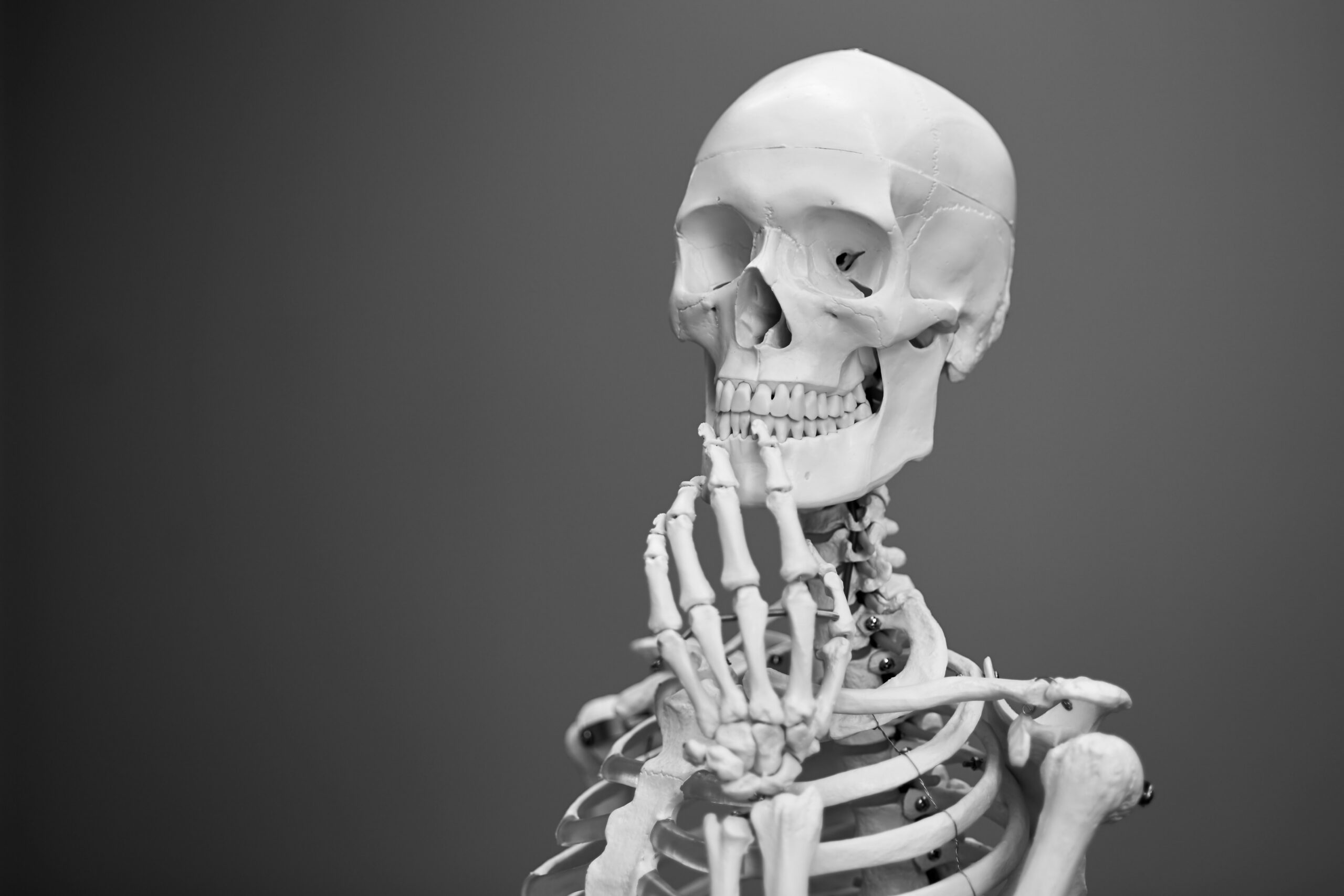
I. Skeleton of the Head (Squelette de la tête)
The skeleton of the head is divided into two parts: the cranium and the face. The cranium is a bony box containing the brain, consisting of an upper part called the vault (calvaria) and a flattened lower part called the base. The face is a bony mass suspended from the anterior half of the skull base.
A. Bones of the Cranium (Os du crâne)
The cranium is composed of eight bones: the frontal, ethmoid, sphenoid, and occipital (all unpaired/median), and the two temporal and two parietal bones (paired/lateral).
1. Frontal Bone: Located at the anterior part of the skull. It has two main parts: a vertical part (forehead) and a horizontal part (orbito-nasal).
◦ Exocranial Face: Divided by the orbito-nasal crest. Landmarks include the glabella (median eminence), the superciliary arches, the frontal bosses, and the temporal crest.
◦ Endocranial Face: Concave, featuring the foramen caecum, the frontal crest, and the sagittal sinus groove.
◦ Orbito-nasal part: Contains the ethmoidal notch, which is bordered by ethmoidal half-cells. It also features the orbital fossae containing the lacrimal gland depression.
2. Ethmoid Bone: Located below the horizontal part of the frontal bone, filling the ethmoidal notch. It consists of four parts:
◦ Vertical Plate: Divided into the crista galli (protruding into the skull) and the perpendicular plate (forming part of the nasal septum).
◦ Horizontal Plate (Cribriform Plate): Perforated by numerous holes for the olfactory nerve filaments.
◦ Ethmoidal Labyrinths: Two masses suspended from the horizontal plate, containing ethmoidal cells. They present the superior and middle nasal conchae on their medial face.
3. Sphenoid Bone: Located in the middle part of the skull base. It consists of:
◦ Body: A cubic center presenting the sella turcica (hypophyseal fossa) for the pituitary gland.
◦ Lesser Wings: Two horizontal triangular plates.
◦ Greater Wings: Deploy laterally and upward, presenting three main foramina: foramen rotundum, foramen ovale, and foramen spinosum.
◦ Pterygoid Processes: Vertical processes consisting of medial and lateral plates, forming the pterygoid fossa.
4. Temporal Bone: Located at the inferior and lateral part of the skull. It comprises three main parts:
◦ Squamous Part (Squama): A large plate contributing to the lateral wall of the skull and featuring the zygomatic process.
◦ Tympanic Part: Forms the bony part of the external acoustic meatus.
◦ Petrous Part (Petro-tympanic): A quadrangular pyramid containing the internal ear and major canals like the carotid canal and facial canal. It presents the styloid process at its inferior face.
5. Occipital Bone: Located at the posterior and inferior part of the skull. It is pierced by the foramen magnum.
◦ Basilar Part: Located anterior to the foramen magnum, featuring the pharyngeal tubercle.
◦ Lateral Parts: Feature the occipital condyles for articulation with the atlas.
◦ Occipital Squama: Large posterior plate presenting the external occipital protuberance (inion) and nuchal lines.
6. Parietal Bone: A flat, quadrangular bone forming the side of the skull vault. It presents the parietal boss and lines for temporal muscle attachment.
B. Bones of the Face (Os de la face)
The face is composed of thirteen bones plus the vomer and the mandible.
• Maxilla: A large bone forming the upper jaw, the floor of the orbit, and the lateral wall of the nasal cavity. It contains the large maxillary sinus.
• Lacrimal Bone (Unguis): A small plate on the medial wall of the orbit.
• Palatine Bone: An L-shaped bone with a horizontal plate (forming the hard palate) and a vertical plate.
• Inferior Nasal Concha: A curved bony lamella attached to the lateral wall of the nasal cavity.
• Nasal Bones: Two small plates forming the bridge of the nose.
• Vomer: A thin vertical plate forming the posterior part of the nasal septum.
• Zygomatic Bone (Malar): Forms the cheekbone and the lateral border of the orbit.
• Mandible: The lower jaw, consisting of a horizontal body (with alveolar parts for teeth) and two vertical rami. The rami end in the coronoid process and the condylar process.
• Hyoid Bone: An isolated U-shaped bone in the neck, consisting of a body, greater horns, and lesser horns.
II. Skeleton of the Neck (Squelette du cou)
The cervical column consists of seven superimposed vertebrae. A typical cervical vertebra includes a body, two pedicles, two laminae, a spinous process, articular processes, transverse processes, and a vertebral foramen.
1. Atlas (C1): The first vertebra, which has no body. It consists of two lateral masses (with cavities for the occipital condyles) joined by anterior and posterior arches.
2. Axis (C2): The second vertebra, characterized by the odontoid process (dens), a vertical pivot that articulates with the atlas.
3. Sixth Cervical (C6): Noted for its prominent anterior tubercle on the transverse process (carotid tubercle).
4. Seventh Cervical (C7): Known as the vertebra prominens due to its long, non-bifurcated spinous process.
III. Functional Anatomy and Architecture
• Facial Cavities: The face is organized around major cavities: the oral cavity, the nasal cavities, the orbits, and the infratemporal fossa.
• Skull Architecture: The skull is an elastic structure reinforced by pillars and arches (Félizet’s resistance beams). These structures, such as the zygomatic and mastoid pillars, transmit mechanical pressures (like those from chewing) to the base of the skull.
• Fontanelles: In newborns, the skull bones are separated by membrane-filled spaces called fontanelles. The largest is the anterior (bregmatic) fontanelle, which is diamond-shaped
I. The Vertebral Column (Columna Vertebralis)
The vertebral column is a long, resistant, and flexible bony rod located in the middle and posterior part of the trunk. It is composed of 33 to 35 superimposed bony elements called vertebrae: 7 cervical, 12 thoracic, 5 lumbar, 5 sacral, and 3 to 5 coccygeal.
1. General Characteristics of Vertebrae
According to the sources, every vertebra consists of the following common elements:
• Vertebral Body: A cylindrical anterior segment with two horizontal faces (superior and inferior) and a circumference hollowed out like a gutter.
• Vertebral Arch: Located posteriorly, it forms the vertebral foramen along with the body. It is composed of two pedicles (anteriorly) and two laminae (posteriorly).
• Spinous Process: A median and posterior projection originating from the union of the laminae.
• Transverse Processes: Two horizontal lateral eminences implanted behind the pedicles.
• Articular Processes: Four vertical projections (two superior, two inferior) that allow vertebrae to articulate with one another.
• Vertebral Foramen: A central opening that, when vertebrae are stacked, forms the vertebral canal to protect the spinal cord.
2. Regional Characteristics
• Cervical Vertebrae: The body is transversally elongated with superior « hooks » (uncinate processes). The transverse processes feature a transversary foramen for the vertebral artery, and the spinous process is often bifid.
• Thoracic Vertebrae: The body possesses costal facets for articulation with the heads of the ribs. The spinous process is long, voluminous, and slopes significantly downward.
• Lumbar Vertebrae: These have a voluminous, kidney-shaped body. The spinous process is a thick, rectangular vertical blade. They also feature mammillary processes and accessory processes.
3. The Sacrum and Coccyx
• Sacrum: Formed by the fusion of five sacral vertebrae, it is a quadrangular pyramid flattened from front to back and curved with an anterior concavity. Its anterior face shows four pairs of pelvic sacral foramina. Its posterior face is convex and irregular, featuring the median sacral crest (fused spinous processes), intermediate sacral crests (fused articular processes), and lateral sacral crests (fused transverse processes). The promontory is the angle formed by its union with the 5th lumbar vertebra.
• Coccyx: A triangular bony piece formed by the union of four to six atrophied vertebrae.
II. The Thoracic Skeleton (Thorax)
The thorax is constituted by the thoracic vertebrae, the ribs, the costal cartilages, and the sternum.
1. The Sternum
The sternum is a flat, elongated bone in the anterior midline of the thorax, compared by the ancients to a gladiator’s sword. It consists of three parts:
• Manubrium: The superior segment featuring the jugular notch and clavicular notches.
• Body (Corpus): The middle segment, which meets the manubrium at the sternal angle. It has lateral costal notches for the ribs.
• Xiphoid Process: The inferior tip, which is often cartilaginous and may be bifid or deviated.
2. The Ribs (Costae) and Cartilages
There are 12 pairs of ribs, classified into three categories: true ribs (1–7, attached to the sternum), false ribs (8–10, attached to the cartilage above), and floating ribs (11–12, with free ends).
• Rib Structure: Each rib has a head (with articular facets), a neck, a tubercle (articulating with the vertebral transverse process), and a body. The body contains a costal groove on its inferior border for the intercostal vessels and nerves.
• First Rib: Distinctly wide and flat, it has superior grooves for the subclavian vein and artery, separated by the scalene tubercle.
3. The Thoracic Cage
The cage is a cone-shaped structure with a truncated summit. It has a superior orifice (bounded by T1, the 1st ribs, and the sternal manubrium) and an inferior orifice (bounded by T12, the 12th ribs, the costal margin, and the xiphoid process), the latter being closed by the diaphragm.
III. The Pelvic Skeleton (Pelvis/Basin)
The pelvis is a bony ring formed by the two hip bones (iliac bones), the sacrum, and the coccyx.
1. Divisions and Openings
The internal surface of the pelvis is divided by a circular relief into two parts:
• Pelvis Major (Greater/False Pelvis): The superior part, bounded by the iliac fossae and sacral wings.
• Pelvis Minor (Lesser/True Pelvis): The inferior part, also called the pelvic cavity, which contains the bladder, internal genital organs, and rectum.
• Superior Aperture (Pelvic Inlet): The boundary between the two, formed by the promontory, sacral alae, arcuate lines, pecten of the pubis, and the superior border of the pubic symphysis.
• Inferior Aperture (Pelvic Outlet): A diamond-shaped opening bounded by the pubic symphysis, ischiopubic rami, ischial tuberosities, and the tip of the coccyx.
2. Sexual Dimorphism
The sources highlight several differences between the male and female pelvis:
• Female Pelvis: The walls are thinner, the superior aperture is more flared and oval, and the pelvis minor is wider. The pubic arch is much broader and more open in females compared to the narrow angle found in males. The sacrococcygeal concavity is also more pronounced in females
I. Skeleton of the Shoulder (Pectoral Girdle)
1. Clavicle
• General Description: The clavicle is a long bone located at the antero-superior part of the thorax, extending from the sternum to the acromion in an oblique direction outwards and backwards. It is shaped like an « italic S, » describing two curves: an internal one concave posteriorly and an external one concave anteriorly. It is flattened from top to bottom, particularly at its outer end.
• Superior Face: This surface is smooth over almost its entire extent. It features inconsistent roughness for the attachments of the sternocleidomastoid (medially), deltoid (antero-laterally), and trapezius (postero-laterally) muscles.
• Inferior Face: It features the subclavian muscle groove in its middle part. It also contains the nutrient foramen, the costoclavicular ligament impression (at the internal end), and the trapezoid line (at the external end). The trapezoid line consists of two segments: an anterior one for the trapezoid ligament and a posterior one featuring the conoid tubercle for the conoid ligament.
• Borders:
◦ Anterior Border: Thick and convex medially (pectoralis major attachment); thin and concave laterally (deltoid attachment).
◦ Posterior Border: Thick and concave medially; convex and rough laterally (trapezius attachment).
• Extremities:
◦ External (Acromial) Extremity: Features an elliptical articular facet that rests on the acromion.
◦ Internal (Sternal) Extremity: The most voluminous part of the bone, presenting a triangular articular surface that responds to the sternum and the first costal cartilage.
2. Scapula (Shoulder Blade)
• General Description: A flat, large, thin, and triangular bone applied to the postero-superior part of the thorax, level with the first seven ribs.
• Anterior (Costal) Face: It is excavated by the subscapular fossa, which is crossed by ridges for the subscapular muscle. Along the external border, it features the scapular pillar, a semi-cylindrical bulge forming the internal lip of the axillary border groove.
• Posterior Face: Divided into two parts by the scapular spine: the supraspinous fossa above and the infraspinous fossa below.
◦ Scapular Spine: A triangular bone blade; its posterior border is thick and features the tuberosity of the spine.
◦ Acromion: A continuation of the spine, flattened from top to bottom, featuring an articular facet for the clavicle on its internal border.
• Borders:
◦ Superior (Cervical) Border: Short and thin, ending laterally at the scapular notch.
◦ Internal (Spinal) Border: The longest border, forming an open angle at the level of the spine.
◦ External (Axillary) Border: Formed by a bone ridge separating the attachments of the teres minor and teres major muscles, ending superiorly at the infraglenoid tubercle.
• Angles:
◦ Superior Angle: Junction of the superior and internal borders.
◦ Inferior Angle: Junction of the internal and external borders.
◦ External Angle: Features the glenoid cavity (articulating with the humerus), the neck of the scapula, and the coracoid process.
◦ Coracoid Process: Shaped like a half-bent finger, implanted on the superior face of the neck.
II. Skeleton of the Arm
Humerus
• General Description: A long bone articulating with the scapula above and the ulna and radius below.
• Body (Diaphysis): Irregularly cylindrical at the top and triangular prismatic at the bottom.
◦ External Face: Features the deltoid tuberosity (V-shaped).
◦ Internal Face: Features the lower part of the intertubercular groove, the nutrient foramen, and the coracobrachialis muscle impression.
◦ Posterior Face: Crossed by the radial nerve groove.
• Superior Extremity:
◦ Head of the Humerus: Represents 1/3 of a sphere, articulating with the glenoid cavity.
◦ Anatomical Neck: Separates the head from the tubercles.
◦ Greater Tubercle (Trochiter): Located laterally, featuring three facets for the supraspinatus, infraspinatus, and teres minor muscles.
◦ Lesser Tubercle (Trochin): Located anteriorly, for the subscapularis muscle.
◦ Intertubercular Groove (Bicipital Groove): Located between the tubercles, it allows passage for the long head of the biceps tendon.
• Inferior Extremity: Flattened from front to back.
◦ Articular Surfaces: The humeral trochlea (pulley-shaped) and the capitulum (rounded eminence), separated by the capitulo-trochlear groove.
◦ Fossae: Coronoid and radial fossae (anterior); olecranon fossa (posterior, the deepest).
◦ Lateral Processes: Medial epicondyle (salient) and lateral epicondyle.
III. Skeleton of the Forearm
1. Ulna
• General Description: A long bone located medially to the radius.
• Body: Triangular prismatic, decreasing in size from top to bottom. The posterior face is divided by a longitudinal ridge. The external border is the interosseous ridge.
• Superior Extremity: Formed by two processes creating the trochlear notch (hook-shaped).
◦ Olecranon: Vertical process forming the posterior part of the notch.
◦ Coronoid Process: Horizontal process featuring the radial notch on its external face for the head of the radius.
• Inferior Extremity: Features the head of the ulna and the styloid process of the ulna.
2. Radius
• General Description: A long bone located laterally to the ulna.
• Body: Curved (concave medially and anteriorly), presenting a nutrient foramen on its anterior face and the interosseous ridge on its internal border.
• Superior Extremity: Includes the head of the radius (cylindrical), the neck, and the radial tuberosity (for the biceps brachial tendon).
• Inferior Extremity: Large and quadrangular.
◦ Inferior Face: Articular, divided into sections for the scaphoid and lunate bones.
◦ External Face: Ends in the styloid process of the radius.
◦ Internal Face: Features the ulnar notch for the head of the ulna.
IV. Skeleton of the Hand
1. Carpus (Wrist)
Composed of eight short bones in two rows:
• Proximal Row: Scaphoid (features a tubercle), lunate, triquetrum, and pisiform.
• Distal Row: Trapezium (features a tubercle), trapezoid, capitate (the largest), and hamate (features a hook-like process called the hamulus).
• The carpus collectively forms the carpal groove (carpal tunnel) on the palmar side.
2. Metacarpus
Composed of five long bones called metacarpals. Each has a body (triangular prismatic), a base (superior end), and a head (inferior end articulating with the phalanges). The first metacarpal is the shortest and most voluminous.
3. Phalanges
Each finger has three segments: proximal, middle, and distal phalanges, except for the thumb, which has only two. They each feature a body, a base, and a head (or trochlea).
4. Sesamoid Bones
Small, seed-shaped bones found in the thickness of certain tendons, primarily on the palmar side of the hand (especially at the thumb’s metacarpophalangeal joint)
I. THE HIP BONE (OS COXAL)
The hip bone is described as a flat, large bone with a highly « tormented » or twisted shape, often compared to the blades of a windmill or a propeller. It is composed of three primary segments that meet at the center of the acetabulum: the ilium (upper), the pubis (antero-inferior), and the ischium (postero-inferior).
1. External Face
The external face is divided into three regions:
• Gluteal Face of the Ilium: A triangular, undulating surface marked by the anterior and posterior gluteal lines. These lines divide the surface into three areas: a posterior zone for the gluteus maximus and sacro-tuberous ligament; a middle zone for the gluteus medius; and an antero-inferior zone for the gluteus minimus. Above the acetabulum lies the supra-acetabular groove for the reflected tendon of the rectus femoris.
• Acetabulum: A deep articular cavity surrounded by the acetabular labrum (bourrelet). It features three notches (ilio-pubic, ilio-ischiatic, and the deep ischio-pubic notch). It contains a non-articular central part called the acetabular fossa (arrière-fond) and a peripheral, crescent-shaped articular surface.
• Obturator Foramen: A large opening (oval in males, triangular in females) located below the acetabulum. It is framed by the pubis (body, superior and inferior branches) and the ischium (body, branch, and ischiatic tuberosity).
2. Internal Face
This face is divided by the arcuate line (ligne arquée).
• Above the line: The iliac fossa, a large, concave surface providing insertion for the iliacus muscle. Posteriorly, it features the auricular surface (for the sacrum) and the iliac tuberosity.
• Below the line: A smooth quadrilateral surface corresponding to the acetabular floor and the entrance to the obturator canal (gouttière sous-pubienne).
3. Borders and Angles
• Superior Border (Iliac Crest): Sinuous « S-shaped » border ending anteriorly at the anterior superior iliac spine (ASIS) and posteriorly at the posterior superior iliac spine (PSIS).
• Anterior Border: Features the ASIS, a notch, the anterior inferior iliac spine (AIIS), the ilio-pubic eminence, the pectineal surface, and the pubic tubercle.
• Inferior Border: Formed by the ischio-pubic branch, featuring the articular surface for the pubic symphysis.
• Posterior Border: Includes the PSIS, the posterior inferior iliac spine, the greater sciatic notch, the ischiatic spine, the lesser sciatic notch, and the ischiatic tuberosity.
II. THE FEMUR (THIGH BONE)
The femur is a long bone articulated superiorly with the hip bone and inferiorly with the tibia. It is inclined obliquely downward and inward.
1. Body (Shaft)
Prismatic and triangular in cross-section with three faces (anterior, postero-lateral external, and internal).
• Posterior Border (Linea Aspera): A prominent, rough ridge. Superiorly, it trifurcates into the gluteal tuberosity (external), the pectineal line (middle), and the line of the vastus medialis (internal). Inferiorly, it bifurcates to bound the popliteal surface.
2. Superior Extremity
• Femoral Head: Represents roughly two-thirds of a sphere, containing the fovea capitis for the ligament of the head of the femur.
• Greater Trochanter: A quadrilateral prominence on the external side; its internal face features the trochanteric fossa.
• Lesser Trochanter: A conical process at the junction of the neck and the internal shaft.
• Neck: A cylindrical, flattened segment connecting the head to the trochanters at an angle of approximately 130°. Its anterior face often shows the iliac imprint.
3. Inferior Extremity
Composed of two condyles (medial and lateral) separated posteriorly by the intercondylar fossa.
• Anterior Face: Features the patellar surface (trochlea), separated from the condyles by condylo-trochlear grooves. Above the trochlea is the supra-trochlear fossa.
• Lateral Faces: The medial condyle features the medial epicondyle and the adductor tubercle. The lateral condyle features the lateral epicondyle and a pit for the popliteus muscle.
III. THE PATELLA (KNEECAP)
A triangular sesamoid bone located in the anterior part of the knee within the quadriceps tendon.
• Anterior Face: Convex and marked by vascular grooves.
• Posterior Face: Articular in its upper three-quarters (divided into two facets by a vertical ridge for the femoral trochlea) and rough in its lower part.
• Base and Apex: The superior base receives the quadriceps tendon; the inferior apex provides attachment for the patellar ligament.
IV. THE LEG BONES (TIBIA AND FIBULA)
1. The Tibia
A voluminous long bone located on the medial side of the leg.
• Body: Features a sharp anterior border known as the tibial crest and a posterior face crossed by the soleal (oblique) line.
• Superior Extremity: Features two condyles with glenoid cavities separated by the intercondylar eminence (tibial spine). Anteriorly, it bears the tibial tuberosity. The lateral condyle includes the fibular articular surface and Gerdy’s tubercle.
• Inferior Extremity: Features the medial malleolus internally, an inferior articular surface for the talus, and the fibular notch externally.
2. The Fibula (Péroné)
A slender long bone on the lateral side of the leg.
• Superior Extremity (Head): Features an articular surface for the tibia and the apex (styloid process).
• Inferior Extremity (Lateral Malleolus): Longer and more posterior than the medial malleolus, it features an internal articular facet for the talus and a malleolar fossa.
V. SKELETON OF THE FOOT
The foot is composed of the tarsus, metatarsus, and phalanges.
1. The Tarsus (7 bones)
• Talus (Astragalus): Transmits body weight; features a trochlea for the leg bones, a neck, and a head for the navicular.
• Calcaneus: The largest bone, forming the heel. It features the sustentaculum tali on its medial face and articular surfaces for the talus separated by the calcaneal groove.
• Cuboid: Located laterally in front of the calcaneus, featuring a tuberosity and a groove for the peroneus longus.
• Navicular: Situated medially, concave posteriorly for the talus and featuring three facets anteriorly for the cuneiforms.
• Cuneiforms (Medial, Intermediate, Lateral): Three wedge-shaped bones located between the navicular and the first three metatarsals.
2. Metatarsus and Phalanges
• Metatarsals: Five long bones numbered I to V. The first is short and thick; the fifth has a prominent styloid process at its base.
• Phalanges: Each toe has three phalanges, except the hallux (great toe), which has two.
• Sesamoid Bones: Two constant small bones located under the head of the first metatarsal.