


Global growth momentum is set to weaken in 2025, with forecasts pointing to a slowdown from 3.1% in 2024 to just 2.9%, as conflicts, climate shocks, and renewed US tariff policies reshape the economic landscape.
US Outlook: Growth Slows, Inflation Rises
The United States faces mounting headwinds. Real GDP growth is now projected at 1.6%, down from an earlier estimate of 2.1%. At the same time, inflation is expected to climb to 3%, well above the previous forecast of 2.3%. Analysts warn that persistent trade frictions and tighter conditions could tip the US into a policy-driven recession by 2026, ending a decade of resilience.
The risk of a global trade war looms large. In a pessimistic scenario, new tariffs could cost businesses up to USD 1.2 trillion, with ripple effects across global supply chains.
The Return of Protectionism
According to Euromonitor International’s Trump Total Agenda scenario, protectionist US trade measures could push global inflation to 5.3% in 2025. Supply chains would face heightened disruptions, while rising import costs would feed directly into consumer prices. Under the most extreme case, inflation could surge even higher, to 5.7%, as the US economy edges closer to contraction.
Lan Ha, Head of Insights for Economies and Consumers at Euromonitor, highlighted the uncertainty ahead:
“The pace of disruption has accelerated with ongoing conflicts, climate extremes, and unstable trade conditions. Volatility is no longer the exception—it’s the new normal.”
Real GDP growth 2024-2030: baseline vs Trump policies scenarios.
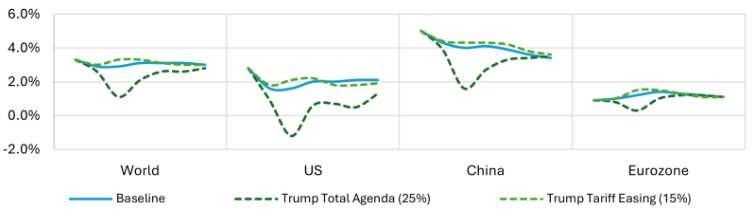
Source: Euromonitor international macro model. Note: Data from 2025 onwards is forecast, updated 7 July 2025
Supply Chains Under Pressure
Geopolitical tensions and extreme weather are already straining global production networks. Manufacturers are shifting toward near-shoring strategies and developing more resilient operations to withstand shocks.
Euromonitor’s Macro Model suggests that a 20–40% spike in commodity prices could push global inflation up by an additional percentage point in 2025, creating even greater challenges for businesses.
In its “Liberation Day” scenario, tariffs could saddle US importers with more than USD 1 trillion in extra costs, while raising component prices for manufacturers by as much as 20%.
Ha noted:
“Uncertainty is now embedded into the global system. To survive, businesses must embrace agility, invest in data-driven planning, and diversify their supply chains. Innovation will thrive only if companies truly understand their consumers and the markets where they operate.”
Asia-Pacific: The Bright Spot
Despite global turbulence, India and Southeast Asia remain standout performers. India’s economy is expected to grow at around 6.5% annually over the next three years, powered by a rising middle class and robust domestic demand.
Multinational leaders are already seizing the opportunity. Firms like Unilever and Nestlé are expanding aggressively in India, with acquisitions and product launches accelerating in 2024 and projected to continue through 2025.
As uncertainty intensifies across much of the world, Asia-Pacific offers a crucial anchor of growth, making it the region to watch for companies seeking stability and long-term opportunity.