

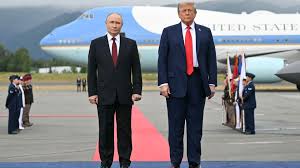
Putin got the red carpet; Ukraine got no results. The Alaska summit, laden with expectations, delivered only disillusionment for those in Kyiv.
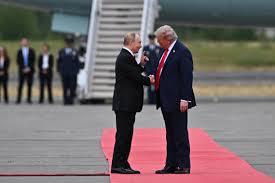 Many Ukrainians were angry to see the US rolling out a red carpet for Putin
Others, however, feared that any agreement might come at Ukraine’s expense — with Kyiv pressured into territorial concessions. Within hours, it became evident that the summit had produced no fundamental change.
No Deal, Just a Show
“There were no concrete results for Ukraine,” said Oleksandr Kraiev of the Ukrainian Prism think tank in remarks to DW.
“Thank God nothing was signed and no radical decisions were made,” he added. “The summit was an extremely successful information operation for Russia. The war criminal Putin came to the U.S. and shook hands with the leader of the free world.”
Kraiev argued that aside from Trump’s “deference toward Putin,” the meeting produced no answers to Ukraine’s key concerns. In his view, Putin manipulated Trump “with surgical precision,” offering flattering lines and feeding him exactly what he wanted to hear. In doing so, the Russian leader walked away with everything he sought from the summit.
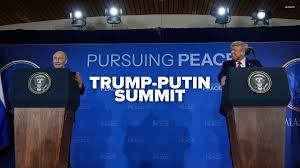 The summit was a welcome return to the international stage for Putin
Ivan Us, a researcher at Ukraine’s Center for Foreign Policy of the National Institute for Strategic Studies, echoed that assessment. He insisted Putin never intended for the summit to bring peace. Rather, his true aim was to legitimize himself internationally and end his political isolation.
“For Putin, a joint photo with Trump was the prize,” Us explained. “He wanted to show the Russian public that the isolation is over, that sanctions aren’t escalating, and that everything is fine — even providing a boost to markets. For Trump, it was about projecting strength. He walked alongside Putin as a U.S. bomber roared overhead, the same aircraft that recently struck Iran. That was his signal: never forget which country remains the world’s most powerful.”
As if to underline the point, Dmitry Medvedev, chairman of Russia’s Security Council, declared afterward that a “full-fledged mechanism for meetings” at the highest level between Washington and Moscow had been restored.
“Important: The summit proved that negotiations without preconditions — even while the Special Military Operation continues — are possible,” Medvedev wrote on social media, using Russia’s official term for its war. “Both sides directly shifted responsibility for future results onto Kyiv and Europe.”
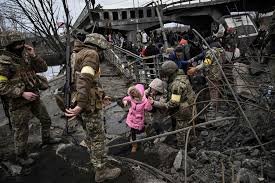 Despite international pressure, Russia continues its war on Ukraine
Uncertainty Deepens
According to Ivan Us, the Alaska meeting left Ukraine no closer to peace. Instead, it fueled more confusion, with Washington and Moscow issuing contradictory statements about the prospect of a trilateral summit involving Ukrainian President Volodymyr Zelenskyy.
Moscow claimed Trump and Putin never discussed such a format. Washington insisted the opposite.
Zelenskyy himself later confirmed that he had received an invitation.
“We support President Trump’s proposal for a trilateral meeting between Ukraine, the U.S., and Russia,” Zelenskyy posted online. “Ukraine emphasizes: the most important issues must be discussed directly by heads of state, and a trilateral framework is the proper one.”
The Ukrainian leader also announced that he would meet Trump in Washington on August 18.
“Ukraine once again confirms its readiness to work toward peace as productively as possible,” Zelenskyy said. “President Trump informed me of his discussions with the Russian president and the key points raised. It is vital that U.S. power continues to influence the development of the situation.”
Pressure Mounting
Still, many in Ukraine fear Zelenskyy’s visit could expose Kyiv to new pressure from Washington.
“Any refusal by Ukraine could be portrayed as unwillingness to end the war,” warned Iryna Herashchenko, opposition lawmaker and co-chair of the European Solidarity party. She pointed to Trump’s suggestion that negotiations involved “territories in exchange for security guarantees,” adding that such rhetoric legitimizes Moscow’s demands.
Herashchenko also noted that Putin repeated his familiar line that “the real causes of the conflict must be eliminated” — code, she argued, for Moscow’s refusal to accept Ukraine’s existence as a fully independent nation.
A Temporary Win for Putin
Political analyst Vadym Denysenko offered a different interpretation. He argued that Moscow’s attempt to trade Ukrainian territory for rapprochement with Washington ultimately failed. Still, he said, Putin managed to buy time.
“At Alaska, they agreed to negotiate,” Denysenko wrote on social media. “But Putin lost what mattered most: his maneuverability. He drastically limited his options and is sliding rapidly into China’s embrace.”
Denysenko predicted that unless tangible progress toward peace emerges within the next two months, the conflict will inevitably become part of the broader geopolitical chessboard between Washington and Beijing.
“In other words, the next genuine window for negotiations won’t come before the end of this year — more realistically, not until spring 2026,” he concluded.
A Summit of Signals, Not Solutions
For Ukraine, the Alaska summit underscored the harsh reality that global power politics, not its own survival, dominated the agenda. Putin achieved the optics he wanted: standing shoulder to shoulder with the U.S. president, demonstrating that he was no longer isolated. Trump, meanwhile, staged a spectacle of strength without delivering substance.
The war rages on. Cities remain under bombardment. Soldiers on both sides continue to die daily. And for Ukrainians who stayed awake through the night, hoping for peace, Alaska was less a breakthrough than a bitter reminder: the fight for their future is far from over.